# (Outdated) Notes
{% tabs %}
{% tab title="S1" %}
## Models of the particulate nature of matter
* Particle nature
* **Matter**
* Pure substance
* Has definite and constant composition
* **Elements**
* All atoms have the same number of protons
* *Ex. Aluminum*
* **Compound**
* A fixed ratio of differing atoms
* *Ex. Water*
* **Mixture**
* A combination of pure substances that retain their individual properties
* **Homogenous**
* Uniform composition (seems like it's made up of one thing)
* *Ex. Honey*
* **Heterogenous**
* Non-uniform composition (can see what it's made up of)
* *Ex. Trail mix (of different nuts)*
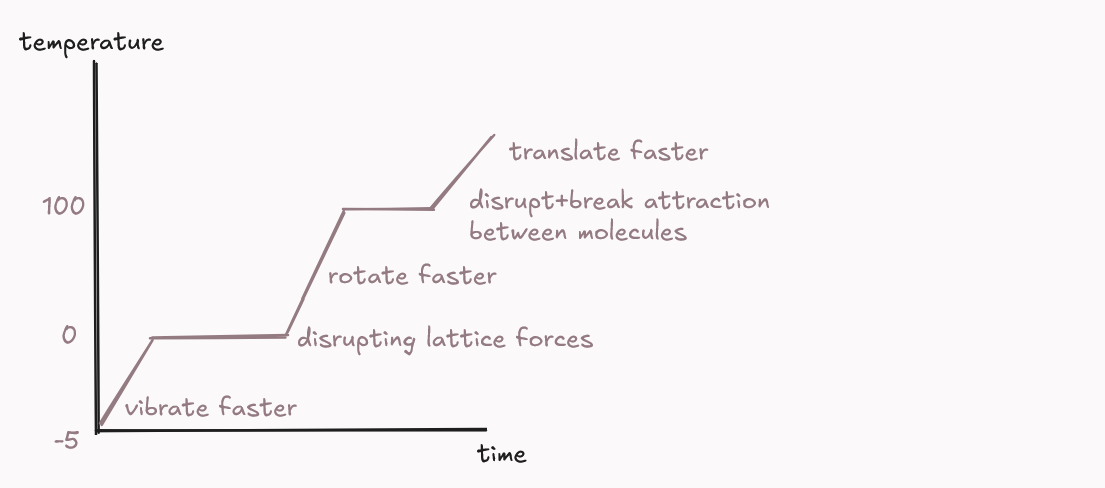
* States of matter
* Solids (melting >) Liquid (vaporizing >) Gas
* Solid (< precipitating, sublimating >) Gas
* Methods of Separating Mixtures' Particles
* **Solvation**
* Based on solubility of different solvents
* *Sand, salty water*
* **Filtration**
* Based on size of particles using a membrane
* *Salt, water*
* **Crystallization**
* Based on ease of evaporation
* *Salt, water*
* **Chromatography**
* Based on particle's affinity varieties for the mobile phase (solvent) or stationary phase (paper)
* **Distillation**
* Based on different boiling points
* *Ex. alcohol, water*
* Atom
* Components
* Proton
* Positive
* \~1 amu
* Neutron
* Neutral
* \~1 amu
* Electron
* Negative
* \~0 amu
* Atomic notation
* A, mass number
* \# protons - # neutrons
* B, atomic number
* \# protons (identifies element X)
* ?, charge caused by loss or gain of electrons
* X, chemical symbol
* \# of protons defines this
* **Isotopes**
* Same element (same # of protons) but different # of neutrons
* Some isotopes are more stable than others, more available in nature
* Differences between isotopes
* Same chemical properties due to same # of valence electrons
* Slightly different physical properties due to # of neutrons
* Relative atomic mass
$$A\_R=x×A\_1×A\_2×A\_3...$$
* **Mass spectrometry**
* **Simply ionized**
* Loses an electron, detected and presented on a mass spectra
* X-axis is m/z, which is mass/charge, Y-axis % of abundance
* **Doubly ionized**
* Loses two electrons, also detected on mass spectra
* Divides mass on X-axis by 2, Y-axis is % of abundance
* Determining relative atomic mass from a mass spectra
* Consider 100 atoms
$$M\_{100}=(A\_1×m/z)(A\_2×m/z)...$$
M, relative atomic mass; A, abundance %, m/z, X-axis data from spectra
* **Electromagnetic spectrum**
* Light splits through a prism into red to violet
* Each color has it's own wavelength, with red = large, violet = small wavelengths
* Difference in energy, red = low, violet = high
* Available in IB data booklet (nanometers = nm = $$×10^{-9}$$)
$$C = f/λ$$
* White light passes through a gas, then exits having absorbed some colors and some not
* *Ex. A high energy gas glows and reflects a specific color. Not continuous, known as emission or line spectrum*
* *Ex. A low energy gas gives an absorption spectrum*
* If the band that is missing in the absorption spectrum is the same band missing in the emission spectrum means it's the same gas
* **Bohr's model**
* Electrons exist at discreet energy levels
* These energy levels get closer together (converge) at higher energies
* Discrete colors are produced when electrons transition to lower energy levels (discrete colors are absorbed when electrons transition to a higher level)
* *Ex. High energy colors are produced from electrons moving from higher levels to a higher level.*
* The spectra has exclusions of energies produced too high and too low to notice. So when they move from closer to more distant ones, they produce the absorption spectrum
* Electron configuration
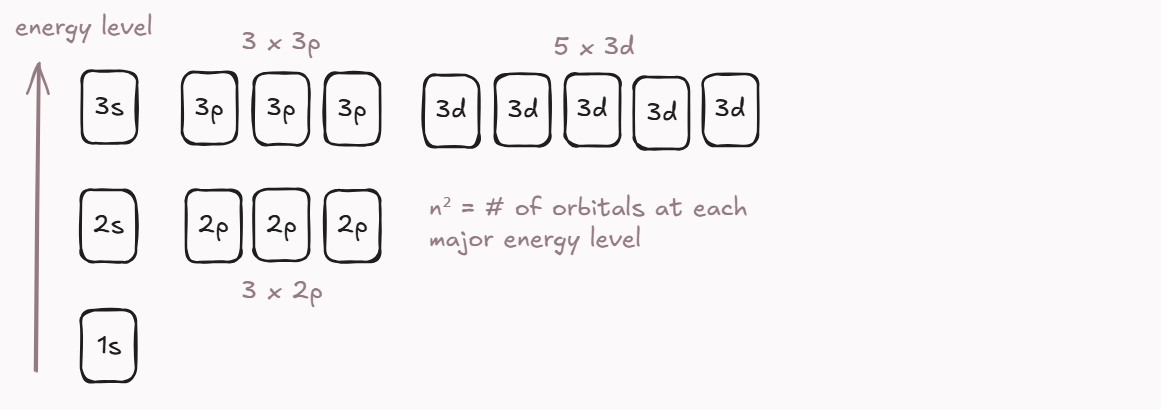
* Energy level diagram
* **Aufbau principle**, electrons fill the lowest energy levels first
* **Pauli exclusion principl**e, an orbital can hold a maximum of 2 electrons with opposite spins
* **Hund's rule**, one electron in each sublevel with parallel spin before doubling up
* Orbital configurations
* 2s orbitals, spherical + max. 2 electrons
* 3×2p orbitals, px/py/pz + dumbbell/peanut + max. 6 electrons
* d orbitals, complex + max. 10 electrons
* f orbitals, most complex + max. 14 electrons
* Energy levels (n) to possible orbitals = $$n^2$$
* How to find the electron configuration from atomic notation or an element
* A block can represent a orbital
* For example, helium (He) with 2 protons, so 2 electrons
* For example, carbon (C) with 6 proton, so 6 electrons
* $$1s^22s^22p^2$$
* For explanation purposes only, the expanded form would be $$1s^22s^22px^12py^1$$ as due to Hund's rule, the electrons go to empty sublevels first before pairing up
* For example, potassium (K) with 19 protons, so 19 electrons
* $$1s^22s^22p^63s^23p^64s^1$$
* Shorthand electron configuration
* Go to nearest noble gas and replace the majority of electrons, adding the extra electron change from the original element
* For K it's Argon (Ar), 18 electrons
* $$\[Ar]4s^1$$
* **Numbered steps**
**1)** Find number of protons of the element (bottom left in atomic notation, Z)\
**2)** Find charge of the element (top right in atomic notation, ?)\
**3)** Subtract charge from # of protons\
\&#xNAN;*(ex. C has 6 protons, if 2- charge, 8 electrons since 6-(-2)=8)*\
**4)** Fill up orbitals by applying Aufbau's principle, where the lowest ones are filled first\
**5)** Apply Pauli's exclusion principle, where each orbital can only have 2 electrons\
**6)** Apply Hund's rule, where in each sublevel (like all of p orbitals) an electron goes to an empty box rather than doubling up first\
\&#xNAN;*(as seen in C's electron configuration)*\
**7)** When going to the next energy level, electrons go back to the s orbital, then fill p, d, etc.\
**8)** Write the electrons in every sublevel as a superscript to the orbital letter
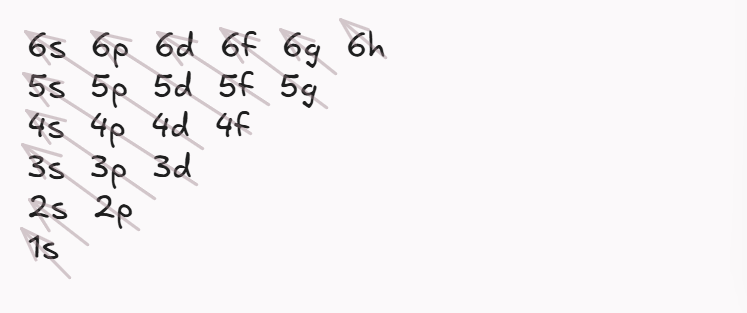
* Order of filling up orbitals is 1s, 2s, 2p, 3s, 3p, 4s, 3d, 4p, 5s, 4d, 5p, 6s, 4f, 5d, 6p, 7s, 5f, 6d, 7p, and so on
* Follow a stitching pattern when filling up orbitals
* Exceptions
* Chromium (Cr) with 24 protons, so 24 electrons
* Expectation is $$\[Ar]4s^23d^4$$
* Reality is $$\[Ar]4s^13d^5$$
* Copper (Cu) with 29 protons, so 29 electrons
* Expectation is $$\[Ar]4s^23d^9$$
* Reality is $$\[Ar]4s^13d^{10}$$
* This is because half full and full orbitals are more stable than partially full orbitals
* Ions
* Anions (-)
* Add the charge to the outermost valence shell
* $${}\_{8}O^{2-}=1s^22s^22p^{(4+2)}=(...)2p^6$$
* Cations (+)
* Focus on the highest principle quantum number
* $${}\_{26}F^{2+}=\[Ar]4s^{(2-2)}3d^6=\[Ar]3d^6$$
* **Emission spectra**
* Focuses on the application of two equations given in the data booklet
* $$E=hf$$
* $$c=fλ$$
* Why does that band show up?
* It's when an electron from the 3rd energy level drops down to the 2nd energy level, producing a red color emission spectra (cause 656 nm is within red's wavelength)
* All finish at a transition finishing at the 2nd energy level
* **What's the energy change of an electron associated with the red spectra in hydrogen?**
* Given $$λ=656×10^{-9}$$ m, $$n=6.63×10^{-34}$$ Js
* Rearrange given equation to $$\frac{c}{λ}=f$$
* Substitute $$f$$ in $$E=hf$$ to get $$E=\frac{hc}{λ}$$
* Substitute all values and solve
$$E=\frac{6.63×10^{-34}Js×3.00×10^8ms^{-1}}{6.56×10^{-9}m}=3.03×10^{-19}J$$
* Ionization
* $$X\_{(g)}+IE⇀X\_{(g)}^{-1}+e^-$$
* With the addition of ionization energy, the element forms a cation as an electron is released
* $$IE=$$ **Ionization energy**
* From data booklet, $$IE=738 kJmol^{-1}$$
* **What wavelength of the electromagnetic spectrum is absorbed to cause the first ionization of the magnesium atom?**
* As seen previously, derive $$E=\frac{hc}{λ}$$, isolate λ
* Magnesium (Mg)'s electron configuration is $$1s^22s^22p^63s^{(2-1)}$$
* -1 from ionization
* The IE from the data booklet is per mole, but the wavelength is per electron
* Divide IE with Avogadro's number
* $$\frac{738kJmol^{-1}}{6.02×10}=1.226×10^{-18}J$$ per electron from a photon
* Substitute values into $$λ=\frac{hc}{E}$$
* $$\frac{6.63×10^{-34}Js×3.00×10^8ms^{-1}}{1.226×10^{-18}J}=1.62×10^{-7}m$$ or 162 nm
* The units cancel out to leave $$m$$ cause it's a wavelength
* **Successive ionization**
* One element and continually remove electrons
* For example, sodium (Na)'s electron configuration is $$1s^22s^22p^63s^1$$
* $$Na\_{(g)}+IE⇀Na^+\_{(g)}+e^-$$
* $$f(x) = x \* e^{2 pi i \xi x}$$
{% endtab %}
{% endtabs %}
[Sirius Revision's playlists](https://www.youtube.com/@siriusrevision/playlists)
{% hint style="info" %}
To the sadness of all 2 people who read this, I will not be finishing these notes.
{% endhint %}
Read my complete chemistry notes on [ZNotes](https://znotes.org/).